
Robert Sinclair RCA
Drawing has dominated all of his work…
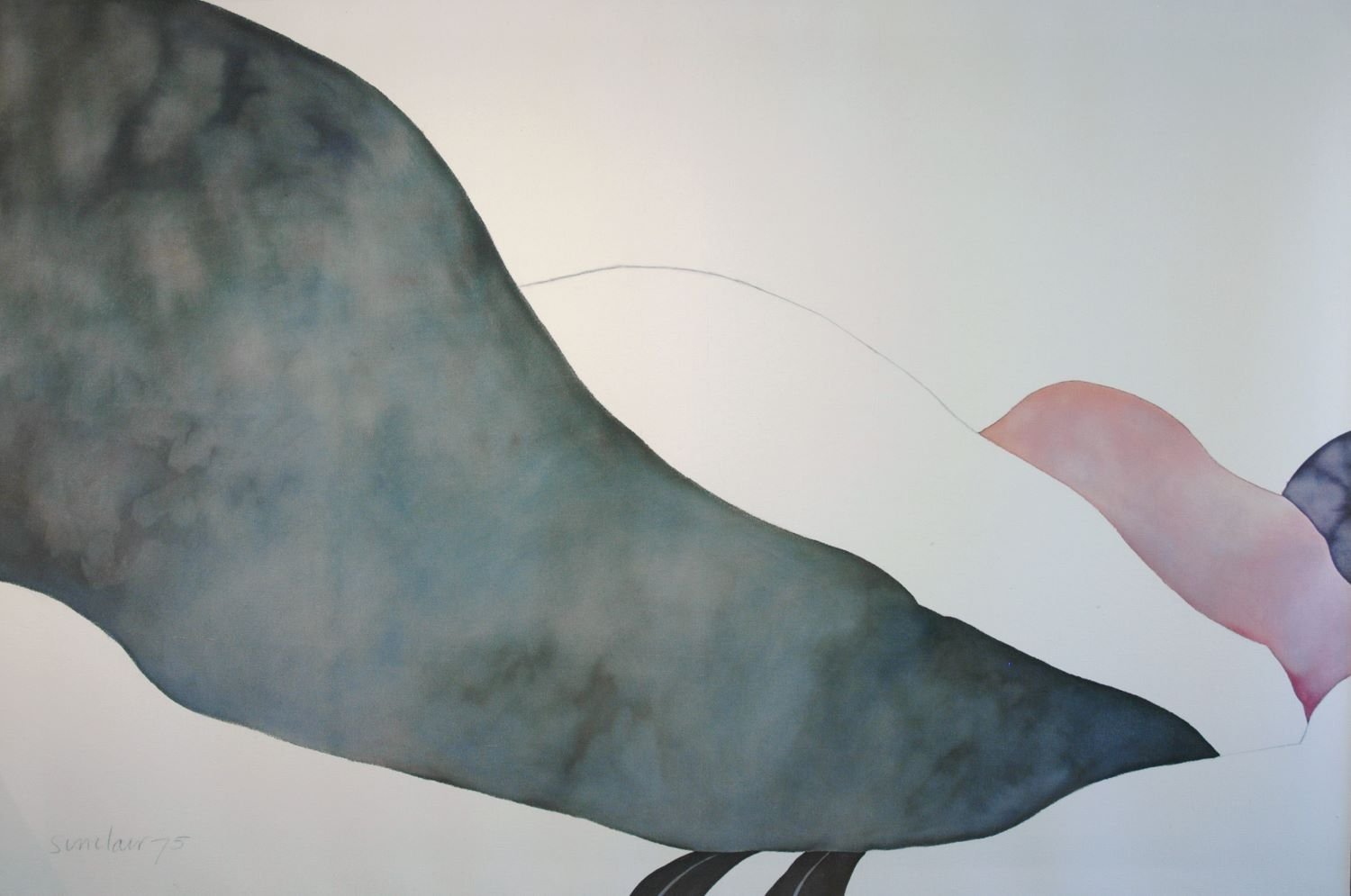
Canada Classic: More Hills (Road Series), 1975, acrylic stain on canvas, 51.5 x 77 inches (131 x 196 cm), provenance: private collection (Toronto), conservation with new framing, $13,500 Cdn.

Canada Classic: Ribboned Run (Road Series), 1980, acrylic stain on canvas, 37.5 x 80.5 inches (95 x 204.5 cm), conservation and new framing, $12,500 Cdn.
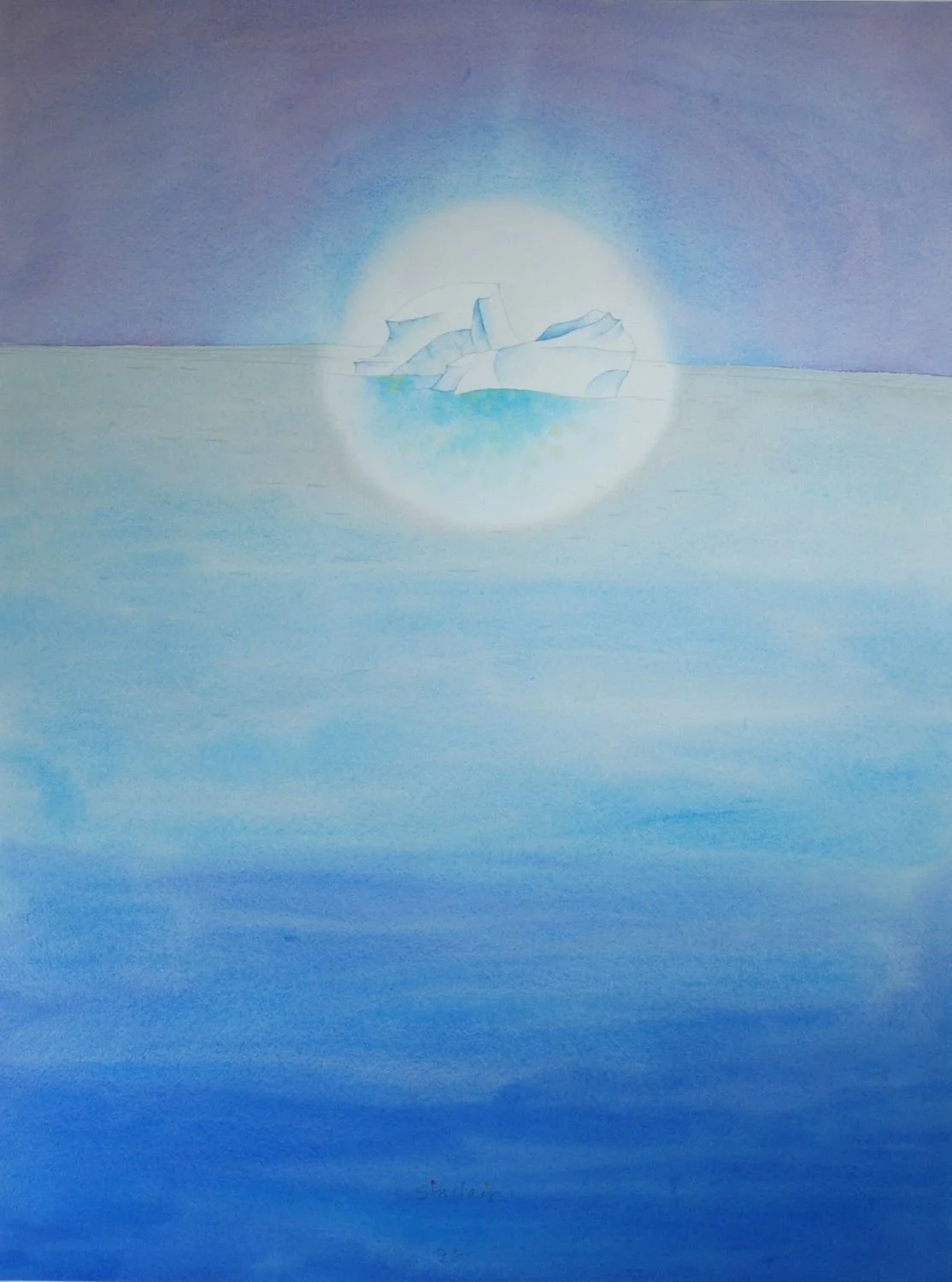
Quiet Passing (Iceberg Series, Newfoundland), 1996, watercolour/paper, 24 x 18 inches (61 x 46 cm), provenance: private collection (Banff), framed, $1100 Cdn.
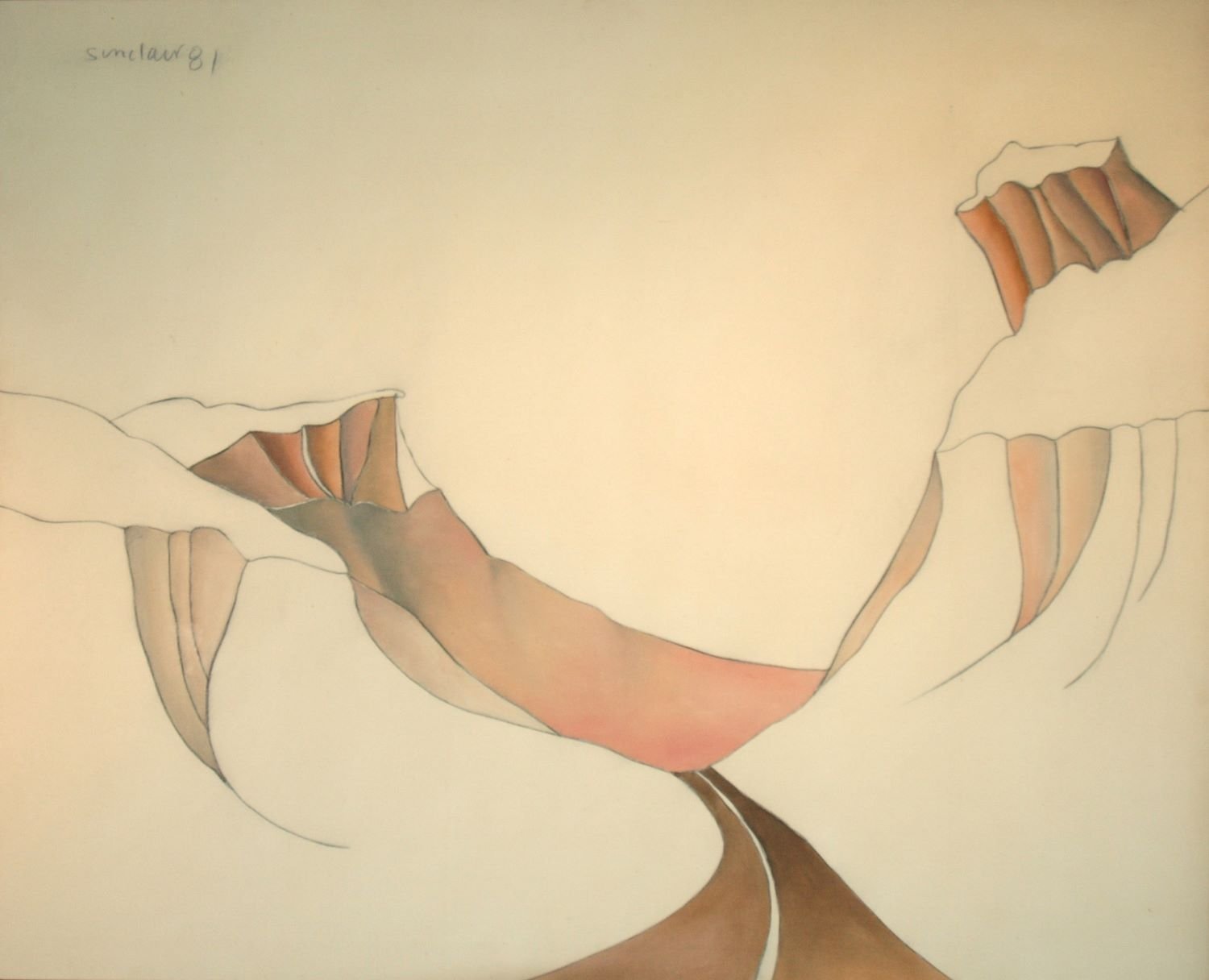
Canada Classic: Rising Presence (Road Series), 1981, acrylic stain/canvas, 49 x 60 inches, sold.
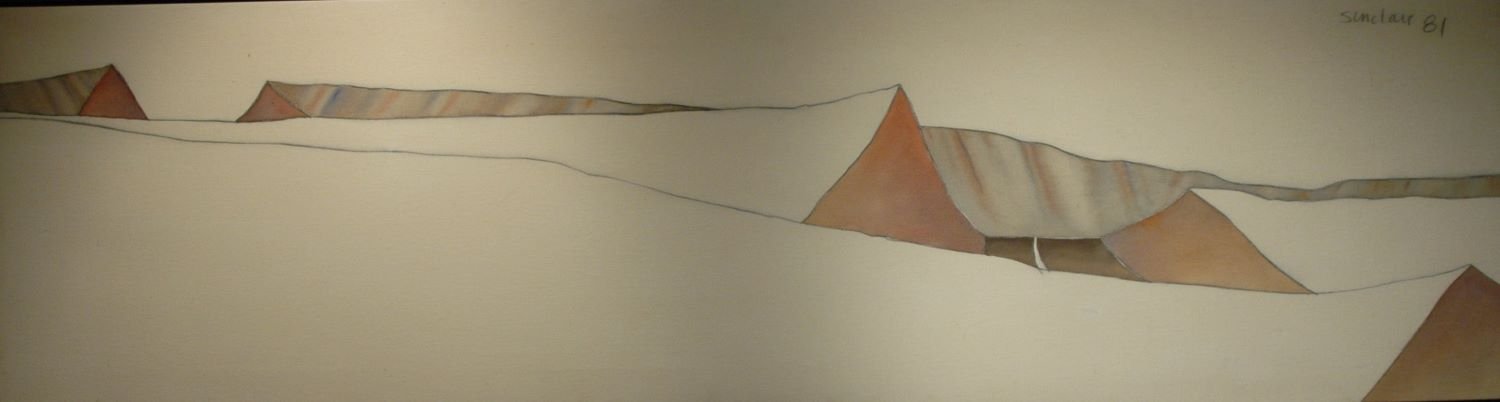
Canada Classic: Stretch (Road Series), 1981, acrylic stain/canvas, 19.5 x 72 inches (49.5 x 183 cm), conservation and new framing, sold.
"Robert Sinclair has developed a uniquely western Canadian theme in his landscape paintings and sculpture. In many of his best-known works, he employs the highway as a familiar shape—a painted-road device that draws the eye into a simplified two-dimensional composition. It creates an immediate illusion of space, yet this is counterbalanced by strongly drawn linear elements and paradoxically unpainted areas that flatten the surface. Sinclair's landscapes portray the connections between observed states: sky, hills, mountain peaks (Kathleen Laverty, 2008)."
Working from a modernist perspective, Sinclair pares his subject matter down to its most elemental forms—comfortable within the language of abstraction and driven by the belief that a little can convey much. He has long pushed the boundaries of his chosen media, often disregarding traditional conventions and adapting techniques from one medium to another. Most notably, he developed a proprietary sealant for canvas that eliminated the need for gesso. The sealed canvas retains the appearance of raw surface while remaining protected, upon which he applied acrylic as a stain using a modified transparent watercolour technique—a radical approach that blurred the distinction between painting and drawing. This willingness to experiment across materials and methods characterized a career built on innovation rather than adherence to established rules.
Sinclair's Road Series, spanning the late 1960s to the early 1990s, established his national reputation. Executed in multiple media—including paintings, works on paper, and plexi-based sculptures—the series early emphasis on the prairie was later expanded to include foothills and mountain scenes, while retaining its commitment to simple line and form. It originated from a deliberate critique of the Canadian art establishment's fixation with the Group of Seven's "pristine wilderness" imagery. Having grown up in the prairies rather than Ontario, Sinclair introduced the road into his open landscapes to reflect the reality of Western Canadian life, where distance and isolation are defining factors. Each stroke is economical; each mark intentional. The Road Series captures not just a geography, but a sensibility—one shaped by his experience of the vast prairie horizon, long drives home, and the quiet space between places.
A distinguished figure in the Canadian art scene, Robert Sinclair worked at the intersection of abstraction and floral and/or landscape painting since the mid-1960s. His sparse, nearly ethereal landscapes and botanical studies are deceptively informal and lyrical. He holds an MFA from the University of Manitoba and both an MA and MFA from the University of Iowa. He taught in the Department of Art and Design at the University of Alberta from 1965 until his retirement in 1997, serving as a visiting professor at numerous universities across Canada and overseas. Since retiring, he continued, until recently, to conduct art workshops domestically and internationally. A member of the Royal Canadian Academy of Arts and the Canadian Society of Painters in Watercolour, Sinclair has been regularly exhibited since 1972, and his work resides in major public and private collections including the Canada Council Art Bank, Whyte Museum of the Canadian Rockies, Glenbow Museum, Alberta Foundation for the Arts, Art Gallery of Windsor, and the Royal Collection of H.M. the Queen at Windsor Castle.